It was 1995, roughly five and a half years since the Berlin Wall had come down and Germany had become unified. I was a frizzy-haired sixteen year-old with Coke-bottle glasses, a prominent retainer, and a faded, royal blue, second-hand coat at least one size too big for me. I clutched my Euro-rail pass, an Agatha Christie novel, and a brown paper bag full of waffles. I was on my way to Zerbst, the town whose last name I share – a name with a storied past, a cumbersome amount of consonants, and a first letter which always put me at the end of a line, not to mention a name for which I had been teased about my entire life.
I had been studying in Paris that winter and had taken the train to Dusseldorf, where a friend, who had been an exchange student at my school the year before, lived. It was the first time I’d traveled to Germany. I had instantly liked Dusseldorf, which gleamed with shiny streetcars, colorful flowers, and idyllic, quaint neighborhoods right out of a museum painting.
One afternoon, while having tea with my friend’s mother, she asked me about my name.
“You know there is a town called Zerbst in Germany, don’t you?”
“Yes, I know.”
“Wouldn’t you like to go there?” I shrugged and she immediately picked up the phone. She was a judge in Dusseldorf, and so she contacted the court in Zerbst. Wouldn’t some high-school student in Zerbst like to have an American exchange student for the weekend, that is, arriving the next day? And so, it was arranged. And so, I found myself on the ICE heading east.
I didn’t have a proper seat. The Berlin-bound bullet train was crowded. I sat on the floor by the bathroom, next to a dozing soldier sitting on his duffle bag. Despite the discomfort, the train felt cozy; the passengers were dressed colorfully and were chatting away, reading or playing cards. Children slept with their heads on their parents’ shoulders. I stared out the window, watching the countryside pass by – fields of various shades of green and brown, church steeples nestled in the distance, and endless amounts of giant, geometric, almost anthropomorphic telephone towers, which seemed to dutifully march along carrying graceful strings of telephone wires. The farther east we travelled, the telephone towers became fewer and fewer, and at some nondescript, unnoticed location their shapes changed entirely.
The train pulled into Magdeburg, our first major city in the former East Germany. I got out. Everyone looked at me as I got off, as if they were concerned and felt they should ask me if I wasn’t getting off at the wrong station; I was the only one who left the train.
I descended into a world where everything was grey, including the sky. For as far as the eye could see, there were rows of barren, concrete train platforms, and somewhere in the distance through the din was the dark outline of some sort of industrial complex with large smoke stacks and lots of wires. Not a single person was to be seen. I felt as if I were standing on an empty stage and there might be an echo if I opened my mouth. I apprehensively watched as the train pulled away from the station.
I pulled a limp train schedule out of my pocket. My friend’s mother had circled the train I was supposed to take next, but I couldn’t figure out where to go. As if on cue, a conductor appeared on the platform. I tried to ask her where I should go (there was no echo), but she spoke no English, and no French. I decided at that moment that I had to learn German (which I started studying the following year.) Somehow, I managed to find in the maze of empty platforms the train to Zerbst.
It had gotten dark. I hesitated for a moment before stepping onboard. The train was army green, dented, and all the lettering was in Russian. On the inside, it felt more like the old, beat-up New York City subway cars I knew from home than it did a regular train. None of the few passengers paid any attention to me, except the conductor who when he got to me, clearly didn’t know what to do with my Euro-rail pass and, after realizing I didn’t speak German, simply punched several random holes in it with gusto.
The train clacked and swayed as we moved along. The stations we pulled up to were lit only by a single light bulb suspended from a dark ceiling. I couldn’t see any signs indicating the names of the towns. I became nervous that I would miss my stop. Fortunately, however, Zerbst had a better lit station, and when I got out, I was greeted by a smiling girl my age, a kind-faced woman who was clearly her mother, strangely, a woman enthusiastically playing an accordion, and an awkward, pock-faced young man with a large, old-fashioned camera hung around his neck. Despite the entourage, I had to have a moment to stare at my name painted in large letters on the station wall. Zerbst. What a discombobulating feeling. It is a strange name, after all, and there it was on the wall. Could someone still make fun of me if my name appeared in large letters on a wall?
There was a flurry of greetings and an introduction to the man, who was a journalist from the Zerbst Gazette. Again, how strange! The journalist wanted to know, was I descended from Catherine the Great? She was, after all, a Zerbst too. Frankly, I didn’t really know. My grandfather always said we were related. He liked to point out his resemblance to her in a portrait of her as an old woman. I have to say, it is the only portrait of her where I see any resemblance, and I think apart from sharing a large, aquiline nose, their only other similarities were that they were both elderly. The journalist took lots of pictures anyway.
My host family drove me to their home full of smiles. They tucked me into bed, after a laugh about the bottom of my socks, which had Zerbst written in marker so they wouldn’t get lost in the school laundry. In the morning, I was proudly shown their collection of telephones and remote controls for their television. I bathed using a crude, rubber hose attached to the faucet in the bathtub, which offered only a trickle of water. And then, we were off to explore the town.
I quickly noticed that their house was far nicer than the others in the neighborhood. But despite the crumbling exteriors of the houses, they all had little satellite dishes pointed in the same direction. Behind their street was a wide row of gardens where several of their neighbors were stooped in the mud tending to vegetables. We waved to them, and they cheerfully waved back.

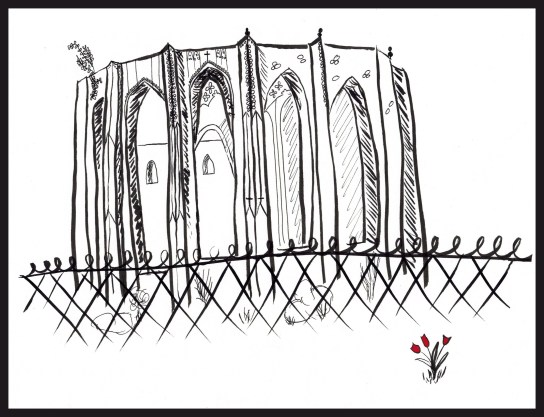
We drove through town, where there was row upon row of drab, Soviet-style blockhouses which seemed to have been plopped haphazardly on the ground over crisscrossing cobble stoned streets, many of which had old trolley tracks which ran under the buildings, the ghosts of a more bustling era in the town history. Zerbst, I learned, had been heavily bombed in early April 1945 by the Americans. I didn’t really need to be told. The scar of the war was everywhere. A lone statue dating from the sixteenth century commemorating the soldiers lost in the crusades stood dejected, surrounded by bloc housing. Every church or cathedral we passed was a charred, roofless skeleton, surrounded by rubble and barbed wire fences. Several of the churches were covered with blue tarp, where inside parishioners still held services. I was proudly shown a bright yellow phone booth, the only speck of color in the whole town it seemed, which had been the only phone for the whole town until a few years prior. I then understood why my host family had been so keen to show me their phones. We went too to the ruins of the castle, which had been a hospital during the war until it was bombed, killing all the patients inside. We picked our way through the barbed wire fence and over the litter and chunks of debris circling the ruins and entered the building. Inside, the great hall was covered in graffiti and broken glass and the sweeping, grand staircase where perhaps a young princess once descended in a splendid gown, led only to the sky.
Oddly, when I made the trip back to Dusseldorf, more than the fact that I had been to a town whose name I share, I was struck by the lasting impact and burden of a war fought fifty years before, a war we in America have no daily reminder of, where we as a society have no such reminder of the brutality of war at all.
 hilaryzerbst.com
Hi Hillary, How well you described your visit and experience!! Charming and interesting as well as entertaining and loved your sketches!! Look forward to reading your book(s).
Louise A. Marasso, ASID
LikeLiked by 1 person
Thank you Louise! I look forward to sharing more. 🙂
LikeLike
Than you for this beautifully written story which I so well remember. You were only 16, traveled by yourself and at that time did not even speak German! You are still a storyteller and world traveler!
LikeLiked by 1 person
Awesome!!
LikeLiked by 1 person
Very entertaining!
LikeLiked by 1 person
Thank you Claire!
LikeLike
Thank you for taking me back to Europe in the 1990’s with your 16-year old self – it was a fun and interesting adventure! Beautifully written, Hilary!
LikeLiked by 1 person
Thank you Leah! That means a lot coming from you!
LikeLike