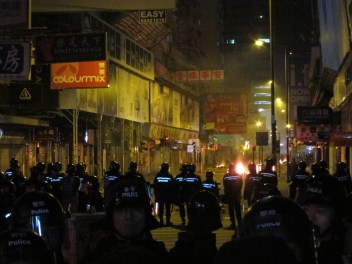
 Hong Kong is practically synonymous with good food—think dim sum. Especially in the 1950s and ‘60s, street food vendors used to roam the streets with carts full of all sorts of delicacies. In the 1970s, the British colonial government imposed regulations on the beloved food carts for sanitation reasons, which have become stricter over the years. Earlier this month, however, riots erupted in Hong Kong when the police shut down unlicensed vendors during a Chinese New Year celebration. The rioters represented a localist movement which protests the perceived infringement by mainland China upon Hong Kong’s distinct culture and rights promised to them at the time of the 1997 handover from Britain. Clearly these riots were not just about street food. Looking to history, however, we see mixed themes of discontent in Hong Kong and its relations to both the Chinese and British who have governed it.
Hong Kong has experienced violent riots only twice in its otherwise peaceful history. The most recent of these was in 1967, when full-blown riots by mainland Chinese supporters protesting British rule led to fifty-one deaths over an eighteen-month period. At the time, there was a palpable fear in Hong Kong of an invasion by the Chinese. Much has been written comparing these riots to the most recent ones. In 1956, however, even more violent, and lesser-known riots broke out killing almost sixty people in a matter of days.
What caused those riots? Although they too were clashes with Communist Chinese supporters, social issues, however, were a fundamental catalyst. At the time, there were hundreds of thousands of Chinese migrants and refugees living in abysmal conditions in Hong Kong. They lived in sewage-seeped shantytowns tucked in the hills with no running water. Fires and mudslides were rampant. The only access to health care or education was from charities, which could only access a small percentage of that population. These migrants provided much of the work force for the economy of Hong Kong, which had one of the highest growth rates in the world, and accounted for a large percentage of the British GDP. Though their discontent was noted by the British colonial government and did lead to some more public housing, the infrastructure to accommodate the hundreds of thousands of people fleeing China simply never materialized, and made Hong Kong a transitive city for many.
Hong Kong has never truly been a Chinese city, nor was it ever truly a British city. Built by the British upon a pile of rocks, hard working Chinese migrants and entrepreneurs from all over the world created one of the most vibrant, cosmopolitan cities on Earth, one which was, in several ways, a model for modern China. Regardless of who has ruled Hong Kong, and who supports whom, there has long been a unique identity and flavor to Hong Kong that should be respected. Fortunately, the 2016 riots resulted in no fatalities, nor did the 2014 protests. But, until issues of the evolving leadership of Hong Kong have been resolved, we will likely see more such demonstrations. Let’s hope, however, they remain peaceful and respectful resolutions can be made so that Hong Kong retains its special place in the world.
 hilaryzerbst.com