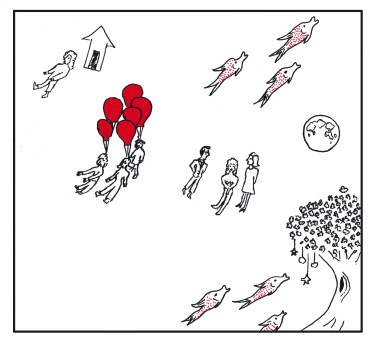
 As a writer, I am frequently asked, “How do you come up with the ideas for your stories?” That seems like a pretty straightforward question, which is usually followed with, “Where do your characters come from? Are they based off of real people? Is your main character really you?” I can provide a well-rehearsed response about the inspirations for my stories and characters, and no, while there are similarities, they are certainly not based on me, my life, or anybody else’s whom I know. I made them all up.
But, they did have to come from somewhere. And that’s when it gets tricky. It is rather humbling to admit, but I feel as if my characters came to me, told me their story, and I just wrote it down. Fortunately, I know I’m not the only writer who feels this way, otherwise I might feel a little crazy. Ideas come to me in bursts at any random time, frequently at inconvenient moments, such as while driving on the highway, and I scramble to jot them down (though not while I’m driving, of course). Later, I string the ideas together and when I sit down at the computer, the story just flows as if I were in a river of dreams, and it just takes me wherever it wants to go. Of course, that doesn’t mean what comes out initially is necessarily good. The final product goes through many rounds of revisions and lots of outlining comes into play, so it’s not as if I sit down on a boat, drift down a river, and turn out a book. But, in working on my first novel I became very aware of, in tune with, and organized around this river of creativity which seems to contain elements of everything I have ever seen, done and felt in my life. I am not even the first person to write about this ethereal, elusive, fleeting river concept of the imagination—the first breath required in the creative process. But that is exactly what it feels like.
I’ve recently been reading a lot about neuroscience, and had an ah-ha moment about the source of this “river” when I read about the emotional brain. Apparently, the “emotional brain,” which is basically the subconscious, stores all of our memories and experiences, and uses them to find patterns which enable the brain to do everything from learn new skills, to recognize signs of danger, to execute daily tasks you no longer have to think consciously of how to do. It is the home of intuition, dreams, and the imagination. It made sense to me that as the brain absorbs and stores every observation, experience, and feeling in life, it recognizes patterns, which the subconscious processes, making seemingly surreal connections and symbolisms, of the sort which frequently appear in dreams, and I believe also provide the foundation for imaginative thinking. It is the fluid, abstract and rapid connections between these elements that lead to the creation of new ideas—including stories and characters.
I know it is a rather abstract answer to a pretty simple question, but there you have it. I can delve into the individual elements of my life which helped form my stories and characters, but not talking about that “river,” would be omitting a huge piece of the answer. Taking the initial ideas that spring from the imagination and crafting them into the final product of a novel with fully developed characters, however, takes discipline and craft, which will be the topic of my next post.
 hilaryzerbst.com
Congratulations Hilary! I can’t wait for your book to come out! I look forward to your future blogs. I met you a couple of times at Mindy & Michael’s home in Fremont, I’m Mindy’s mom.
LikeLike
Hi! Of course I remember you. 🙂 Thank you so much for visiting my site!! I look forward to sharing both the blogs and the book with you.
LikeLike